
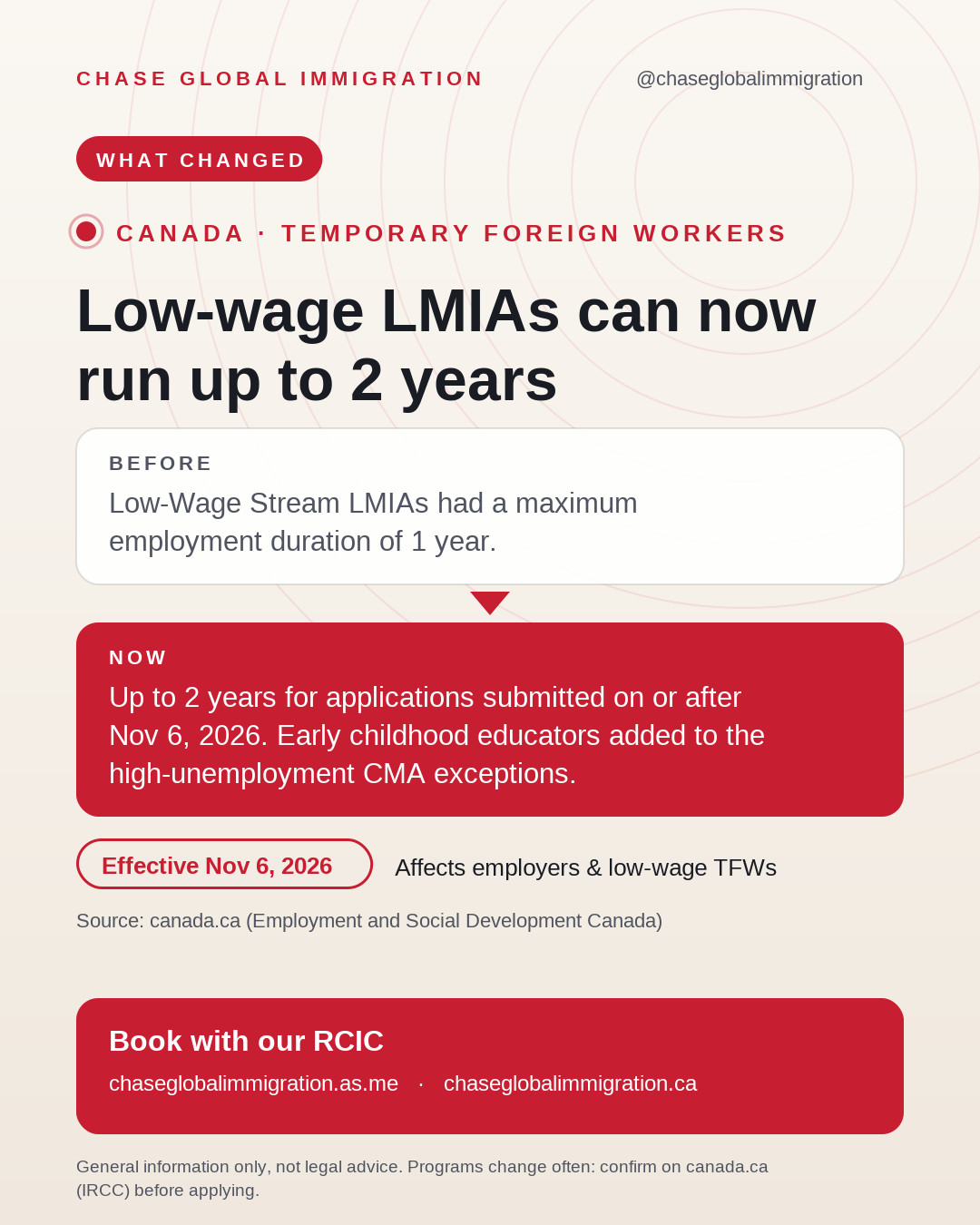
On November 6, 2026, Employment and Social Development Canada (ESDC) announced targeted reforms to the Temporary Foreign Worker Program (TFWP). Two changes to the Low-Wage Stream took effect the same day, and further regional changes are proposed for March 1, 2027.
What changed on November 6, 2026
- Longer LMIAs: Low-Wage Stream LMIA applications submitted on or after November 6, 2026 can have a maximum employment duration of up to two years. Before, the maximum was one year.
- Early childhood educators: low-wage LMIAs are generally not processed in census metropolitan areas (CMAs) with an unemployment rate of 6% or higher, except for priority sectors such as healthcare, construction and food processing. Early childhood educators have now been added to these exceptions.
Proposed for March 1, 2027 (not yet in effect)
ESDC also proposed a regional approach, depending on provinces and territories opting in. CMAs with unemployment of 6% or higher would stay closed to low-wage LMIAs outside priority sectors. Large CMAs (over 250,000 people) below 6%, plus smaller CMAs (100,000 to 250,000), would get targeted access for in-demand occupations identified through the Canadian Occupational Projection System and by provinces and territories. Rural communities would keep full access. In communities that provinces and territories identify, employers could hire low-wage TFWs for up to 15% of their workforce, up from 10%. Priority sectors keep the 20% limit. The Minister will discuss these proposals with provinces and territories in the coming weeks.
Who this affects
Canadian employers hiring through the Low-Wage Stream, temporary foreign workers in low-wage positions, and childcare employers in larger cities with higher unemployment. Budget 2026 also commits $151.5 million over five years to TFWP service delivery and $82 million over four years to the Migrant Worker Support Program.
What to do next
- Employers: new low-wage LMIA applications can now request up to two years. Check the current rules for your CMA before applying.
- Workers: an LMIA is only one step; your work permit application is decided separately by IRCC.
- Not sure how this affects you? Our Regulated Canadian Immigration Consultant (RCIC) can review your options.
Talk to our RCIC
- Book a consultation with our RCIC-led team
- Get a free assessment
Official source
Disclaimer: General information only, not legal advice. Not affiliated with IRCC, ESDC or any government. Always confirm program details on canada.ca before applying.